The Evolution of Artificial Intelligence: From Ancient Tools to Modern Marvels.
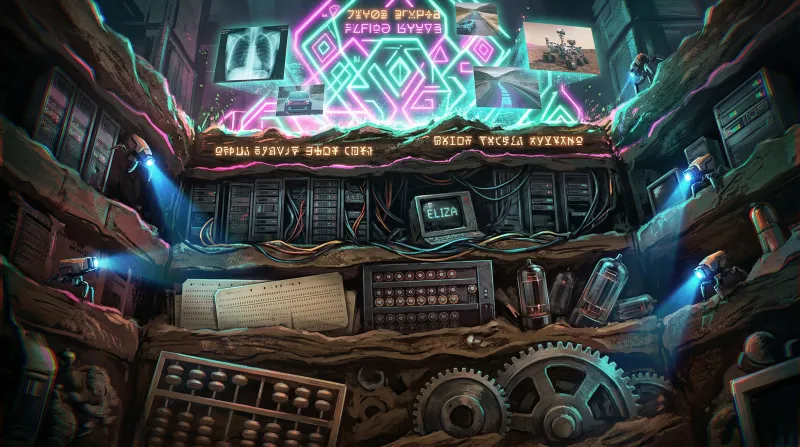
source: Nano Banana
The Dawn of Computational Tools
The journey of artificial intelligence begins in the ancient world, where the simplest form of data processing started with tools like the abacus. This device was not just a calculator but a way to organize and understand data, a precursor to more complex forms of computing.
The Era of Mechanical Computation
Initially presented in 1770 by Wolfgang Von Kempelen, the Mechanical Turk was a faux automaton that played chess against human opponents, including notable figures like Napoleon Bonaparte and Benjamin Franklin. Despite its presentation as a machine capable of playing chess, it was actually operated by a hidden human chess master, making it an early example of “artificial artificial intelligence.”
In essence, the Mechanical Turk serves as a historical bridge between human-operated simulations of intelligence and the development of genuine artificial intelligence, making it a pivotal piece in the history of AI and automation
Fast forward to the 17th cent 19th century, where figures like Charles Babbage and Ada Lovelace began dreaming of automated computing. Babbage’s design for the Difference Engine was an ambitious early attempt to automate calculations, which Ada Lovelace, often considered the first computer programmer, provided the theoretical underpinnings for programming.
The Rise of Tabulation Machines
In the early 20th century, companies like IBM emerged, utilizing mechanical machines to manage and analyze vast amounts of data for things like census counting. This era was marked by the ability to tabulate data, laying the groundwork for understanding and utilizing data on a large scale.
The Birth of Modern AI
During World War II, Alan Turing’s expertise was directed towards cryptanalysis at Bletchley Park, where he played a crucial role in breaking the German Enigma code. His development of the Bombe machine, an electromechanical device that could decipher encrypted messages, significantly shortened the war and saved countless lives.
The conceptual foundation for AI was laid by Alan Turing in 1950 with his development of the Turing Machine and the famous Turing Test, designed to assess a machine’s ability to exhibit intelligent behavior equivalent to, or indistinguishable from, that of a human.
The Golden Years and the AI Winters
The mid-20th century saw rapid advancements with the creation of neural networks by Marvin Minsky and others, and the Dartmouth Conference in 1956, which officially coined the term “Artificial Intelligence.” However, the field experienced periods of stagnation known as “AI winters” during the 1970s and 1980s due to unmet expectations and reduced funding.
AI in Popular Culture and Beyond
AI not only advanced in academic and industrial fields but also captured the public imagination through characters like K9 from “Doctor Who” and the droids from “Star Wars.” These representations kept interest in AI alive and helped in understanding its potential.
Breakthroughs in Competitive AI
The late 20th and early 21st centuries brought AI back into the limelight with significant public demonstrations of its capabilities. IBM’s Deep Blue and Watson, Google DeepMind’s AlphaGo, and the more recent Alpha Zero, all showed that AI could exceed human abilities in complex games, a testament to its advanced strategic thinking and learning capabilities.
AI timeline
- 1940s Turing Machines: Refers to Alan Turing’s concept of a universal machine that could solve any computable problem, foundational for modern computing and AI. Alan Turing publishes Computing Machinery and Intelligence — Analog Robots: Early robots that operated on analog rather than digital systems.
- 1950 Turing Test: A test proposed by Alan Turing to determine if a machine can exhibit intelligent behavior indistinguishable from a human.
- 1951 Minsky Neural Net: Marvin Minsky’s work on Neural Networks (NN), an early effort to mimic the human brain’s network of neurons.
- 1956 Dartmouth Conference: This conference is considered the birth of AI as a field; it’s where the term “Artificial Intelligence” was first coined. — Checkers: The development of AI programs capable of playing checkers, an early example of AI in gaming.
- 1957 Semantic Networks: The creation of semantic networks for storing knowledge and making inferences, a method still used in AI.
- 1966 ELIZA: An early natural language processing computer program created at MIT that could mimic conversation by matching user prompts to scripted responses.
- 1969 SHRDLU: An early natural language understanding program that could interact with a virtual world of blocks.
- 1970–80: Likely refers to the development of the first AI winter, a period of reduced funding and interest in AI research.
- 1976, scientists realized that even the most successful computers of the day, working with natural language, could only manipulate a vocabulary of about 20 words due to limited information storage and processing power
- 1970: Even simple, commonsense reasoning requires a lot of information to back it up. But no one in 1970 knew how to build a database large enough to hold even the information known by a 2-year-old child.
- 1982 Expert Systems ZX81: Refers to the development and use of expert systems, computer programs that emulate the decision-making ability of a human expert. — K9, Star Wars: May refer to fictional representations of robots and AI in popular culture such as the “K9” character from “Doctor Who” and droids from the “Star Wars” franchise. First AI winter caused by high expectations from end users and reduced funding.
- 1987: The year Minsky joined IBM, indicating his move to work with a major corporation on AI development.
- 1993: May indicate the continuation or end of the second AI winter, another period of stagnation in AI funding and interest.
- 1997 Deep Blue Beats Kasparov: IBM’s chess-playing computer Deep Blue defeated world chess champion Garry Kasparov, a landmark moment in AI.
- 2005 DARPA Grand Challenge (self-driving vehicles): A competition sponsored by the U.S. Department of Defense to develop autonomous vehicles.
- 2011 Watson Wins Jeopardy: IBM’s Watson AI competed against former winners on the quiz show “Jeopardy!” and won.
- 2016 AlphaGo: Google DeepMind’s AlphaGo defeated a professional human Go player, a significant achievement due to the game’s complexity.
- 2017 The introduction of the Transformer model by Google researchers was a groundbreaking breakthrough in the field of artificial intelligence (AI), particularly in natural language processing (NLP). The Transformer model introduced a novel architecture based on the self-attention mechanism, allowing it to process entire sequences of data simultaneously, rather than sequentially.
- 2017 Alpha Zero: An upgraded version of AlphaGo that learned to play Go, chess, and shogi without prior knowledge, solely through reinforcement learning.
- 2019 Project Debater: IBM’s AI that can debate on complex topics with humans.
- 2018: OpenAI introduced GPT-1, a model that could generate coherent and contextually relevant text based on a given prompt. This technology evolved to GPT-3 in 2022, significantly enhancing the model’s ability to generate human-like text.
- 2022 K9 Mk2: This could be a reference to advancements or a new iteration in robotics or AI systems, possibly named in homage to the earlier “K9” reference.
- 2022: Launch of ChatGPT-3.
The Current and Future State of AI
Today, AI is integrated into more critical applications such as autonomous driving, healthcare diagnostics, and even assisting in complex debates and discussions through platforms like IBM’s Project Debater. The evolution of AI shows a trajectory from simple mechanical aids to systems that can learn, adapt, and interact in ways that were once thought to be exclusively human. As AI continues to evolve, the potential applications are boundless, promising to redefine technology and society in ways we are just beginning to understand.
Artificial Intelligence (AI) has seen numerous significant advancements in recent years, particularly in 2023. These breakthroughs span various domains, including natural language processing, healthcare, autonomous vehicles, and more. Here are some of the key recent breakthroughs in AI:
Generative AI Models:
- ChatGPT and GPT-4: OpenAI’s ChatGPT, based on the GPT-4 model, has significantly advanced the capabilities of AI in understanding and generating human-like text. This model can handle a wide range of tasks from writing and summarizing to answering questions and more
- Google’s Bard and DeepMind’s Gemini: Google introduced Bard, a conversational AI model, while DeepMind launched Gemini, a model that can process and understand images and audio, enhancing multimodal AI capabilities
Generative AI in Computer Vision:
Generative models like Generative Adversarial Networks (GANs) and Variational Autoencoders (VAEs) have been pivotal. These models can generate realistic images and videos, which are crucial for training computer vision systems without the need for vast real-world datasets, thus preserving privacy and reducing costs.
- Advancements in Deep Learning Models: Deep learning continues to be at the heart of progress in computer vision. Models based on Convolutional Neural Networks (CNNs) have become more sophisticated, enabling more accurate object detection, image classification, and even real-time video analysis.
- Multimodal AI: This involves processing and integrating multiple types of data (e.g., text, images, and audio) to enhance the understanding of visual content. This integration allows for more comprehensive and context-aware AI systems.
- 3D Computer Vision: Advances in 3D computer vision have improved depth perception in AI systems, which is crucial for applications like autonomous driving and augmented reality. Techniques such as using multiple cameras and light sensors help in creating detailed 3D models of environments.
- Ethical and Fair Computer Vision: As the technology advances, there is a growing emphasis on developing ethical AI systems that avoid biases and ensure fairness in applications like facial recognition and surveillance.
AI in Healthcare:
- AI-Driven Diagnostics: AI models are increasingly used in healthcare to improve diagnostic accuracy. For instance, a collaboration between MIT and Mass General Hospital developed a model that assesses lung cancer risk from CT scans.
- Drug Discovery: AI has accelerated the drug discovery process, notably during the COVID-19 pandemic, helping to identify potential treatments much faster than traditional methods.
Autonomous Vehicles:
- Advancements by Tesla and Waymo: Both companies have made significant strides in improving the technology behind autonomous vehicles, enhancing safety and reliability.
AI in Cybersecurity:
- AI-Driven Threat Detection: Companies like Darktrace use AI to detect and respond to cybersecurity threats in real time, significantly improving the security posture of organizations.
AI in Environmental Monitoring:
- Climate Change and Conservation: AI is being used to analyze large datasets to track climate change and assist in conservation efforts, such as monitoring deforestation and wildlife populations.
Ethical AI and Bias Mitigation:
- Focus on Responsible AI: There is a growing emphasis on developing AI in an ethical manner, ensuring that AI systems are fair, transparent, and accountable. This includes efforts to mitigate biases in AI algorithms and ensure they do not perpetuate existing inequalities.
AI in Education:
- Personalized Learning: AI technologies are being integrated into educational platforms to provide personalized learning experiences, adapting content to meet the individual needs of students.
AI in Space Exploration:
- Support for Missions: AI is playing a role in space exploration, helping to analyze data from space missions and enhance the automation of spacecraft.
These breakthroughs not only demonstrate the versatility and potential of AI across different sectors but also highlight the rapid pace at which the field is evolving. As AI continues to advance, it is expected to become even more integrated into our daily lives, transforming industries and offering new solutions to complex challenges.
Conclusion
The evolution of AI has been a testament to human creativity and technological progress. As we stand on the brink of AI becoming an integral part of our daily lives, it’s exciting to think about what the next chapters of this story will hold.