The AI Factory Model: Lessons from Amazon, Netflix, and Other Tech Giants
Source: image by author
To rearchitect a business into an AI Factory, you have to change the way the business gathers data, uses data, reacts to information, makes decisions and executes tasks.
In this article I will explain what an AI factory is and why a modern business should transform to this model. After reading this article you should have an idea of what it involves, what the main components are and how you can start implementing the AI factory model into your business. So let’s get started.
Introduction
AI systems aren’t required to be able to reason on the same level as humans (also known as strong AI or AGI). Instead, most of the time, “Weak” or “Narrow” AI models with a more specific purpose such as replacing a single human action, performing a classification or making a prediction will be exactly what we need.
Weak AI is already enough to transform your business and operations. Or to prioritize content on a social network, analyze customer data or determine an optimal price for you products and services.
However, due to the unique nature of everything involved in implementing AI in your business practices, a lot of the old assumptions surrounding strategy and leadership no longer apply.
A New Digital Operating Model
Two key concepts shape and drive a company’s value:
- The Business model: this model describes how the business will create and capture value also called the Value Proposition or Value Creation. This will dictate how the customer problem is solved and why the customer should choose this business. On the other side there is the Value Capture. Basically the value a business captures from the customer should be less than the the business needs to create the value for the customer. In other words the cost to create should be lower than the price charged to the customer.
- The Digital Operating Model is how the business will deliver and capture that value. The goal is to deliver value at Scale, create enough Scope and to respond to change based on Learning. Digital technology like software and data driven algorithms replace labor as the bottleneck.
The core of a Digital Operating Model should be a sophisticated data platform that gathers data that enables you to easily gather and manage every piece of valuable data. This data can then be used by AI algorithms for tasks like personalization, revenue optimization an recommendations to understand and learn and to improve the value creation and define new products and services.
The main goal of this new Digital Operating Model is to avoid direct human interaction as much as possible. This changes management, transforms the growth process and removes traditional bottlenecks constraining Scale, Scope and Learning.
Scale
Scale means that the operation or process should be able to scale unlimited. Today the human factor is a bottleneck and companies reach a plateau at a certain size of employees to be able to keep running smoothly. When Amazon digitizes an operating task, such as recommendations. Amazon is able to scale its digital systems faster and better and continue to improve no matter the size and complexity of the operation. These practices are at the very core of what enabled Amazon to grow to the size that it has today.
Scope
Scope means that there should be more variation in products and services. Amazon started with books and step by step added more products and services. Today Amazon does not only manage Amazon Retail but also Amazon Web Services(AWS), Amazon MGM Studios, Amazon Prime Video, Amazon Games, Audible, Twitch, Ring to name a few.
For example AWS started with a simple S3 storage system, and over time added more and more services. Today AWS offers over 200 different services to meet their customers demands and technological advancements.
Learning
Learning is key in this AI-driven operating model, the results of the learning are used in experiments to define the best way to move forward. Amazon tracks everything and runs it trough their algorithms. These algorithms will learn and become better the more data they get. Based on this learning they will set up new experiments.
To give you an idea, Amazon runs approximately 100.000 experiments per year to validate the insights they get from their algorithms. Once validated they will put the new learning into production.
At Amazon humans are removed from the critical path as much as possible and computers are telling humans what to do not the other way around.
The AI Factory
An AI Factory is a scalable decision engine that powers the Digital Operating Model and treats decision making as an industrial process.
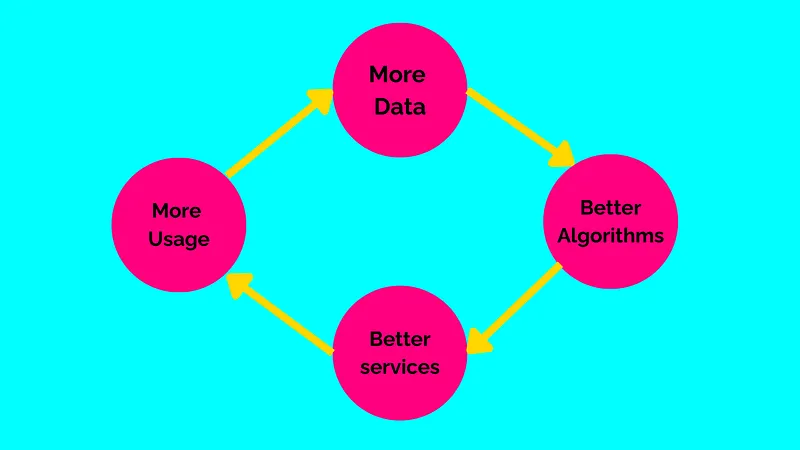
The AI Factory is a cycle of:
1. Getting data
2. Run algorithms on the data,
3. Predict and improve.
So the more data the better the algorithms the better the services and more usage of the services. This will provide more data and the cycle continues.
Source: image by author
The AI Factory Consists of 4 Key Components:
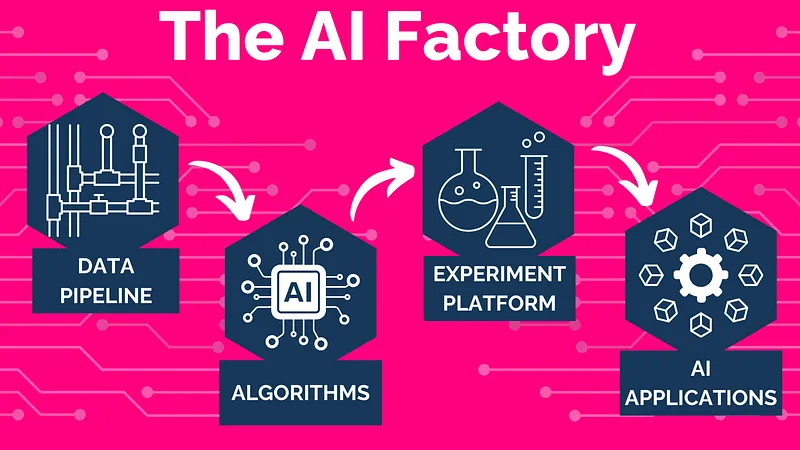
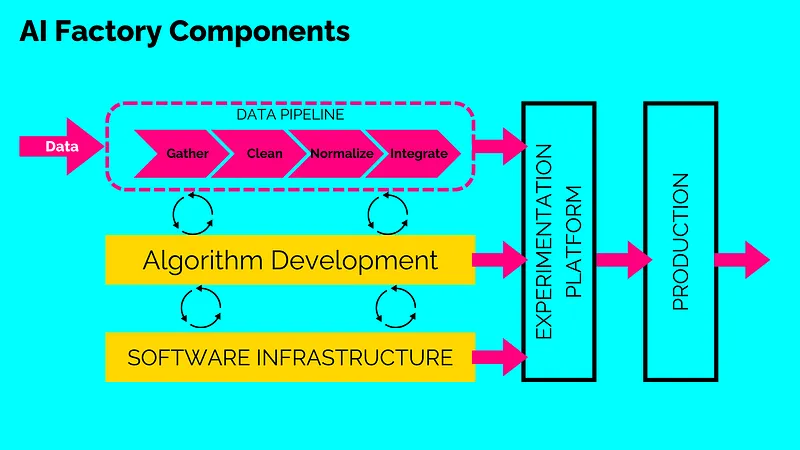
- A Data Pipeline is a process that gathers, inputs, cleans, integrates, processes and safeguard data in a systematic, sustainable and scalable way.
- The Algorithms generate predictions about future states or actions of the business. These algorithms and predictions are the beating heart of the digital firm, driving the most critical operations and processes.
- The Experimentation Platform is a mechanism trough which hypotheses regarding new predictions and decision algorithms are tested to ensure that changes suggested are having the intended and expected effect.
- The Software Infrastructure makes the data pipeline available in a way that is consistent, componentized and can be connected to as needed. This makes the data accessible for algorithms, experiments and applications, both internal and external at any time and location.
Source: image by author
AI Factories in the Real World
We all know them but maybe never realized these companies implement this model. Jeff Bezos realized in 2002 something was needed to change if Amazon should be able to keep growing. He wrote an email to the whole company that from now on every team and department should focus on creating APIs to provide their data to everyone inside and outside of Amazon.
Netflix is also an AI Factory, and the scale at which they are operating is immense. They are constantly capturing data, run predictions and testing them. When something has a positive outcome, it will go into production. At Netflix, the result is that there is basically a customized application for every user. They track what you watch, how long you watch, whether you press forward or rewind, how long you hover on images, what device you use and so on. All this data is used to recommended movies and series, adapt the images you see, or even prevent customer churn, all based on your behavior and preferences.
Another great example but probably less famous is Ant Group, an affiliate company of the Alibaba Group. Ant Group has 16,660 employees to serve 1.3 billion users and 80 million merchants, Ant Group was built with scale in mind. They have a 3–1–0 system to provide a loan. It takes 3 minutes to apply, 1 second to calculate the approval and zero humans are involved.
The Impact on Humans
There will be an impact on human labor, there is no doubt about that. But human labor will take on another dimension. Where today humans do the labor, in this new model, humans will be the creators and managers of AI Factories. New roles will be created because now humans can focus more on how to create and capture value. Humans will define the algorithms and the KPIs that need to be met. They will run the experiments and decide on the outcomes.
But I am a fan of Augmented Intelligence, a definition from IBM that believes in AI that will support humans instead of replacing them. I believe it’s better to train your employees and transform your company into an AI Factory, tripling your output and revenue, as opposed to replacing humans to simply save costs.
Conclusion
I just scratched the tip of the iceberg here about AI Factories. There are still many thing to discover and to explain, which I will do in the next articles. Things like the New Network Effects, Learning Effects, Clusters, and Network Bridging.
But for now you have to keep in mind that the new Digital Operating Model is all about Scale, Scope and Learning to create and capture value. And to be able to do this you need a change of culture. You need to have a Data Pipeline that feeds Algorithms so the results can be tested in the Experimentation Platform. And all of this needs to be running in your Software infrastructure that handles both the AI Factory and the AI applications you build.
But keep in mind that you don’t have to be the size of Amazon or Netflix. You can apply this knowledge today in your own company or startup by thinking ahead. Think about which data you want to gather and make sure it’s clean and is meaningful. This can be as simple as storing it in a spreadsheet or database, as long as you think about how you can scale it in the future.
You can already run predictive algorithms on your data through Copilot, MLStudio or Google AppSheet. And there are many tools to allow you to experiment with your applications and business processes. This could be A/B testing your applications or write two manuals about how a process should be handled and switching between them, and measuring the experience and results.