Cyborgs, AI, and Credsticks: How Sci-Fi is Shaping Our Future
The Blurring Line Between Science Fiction and Reality
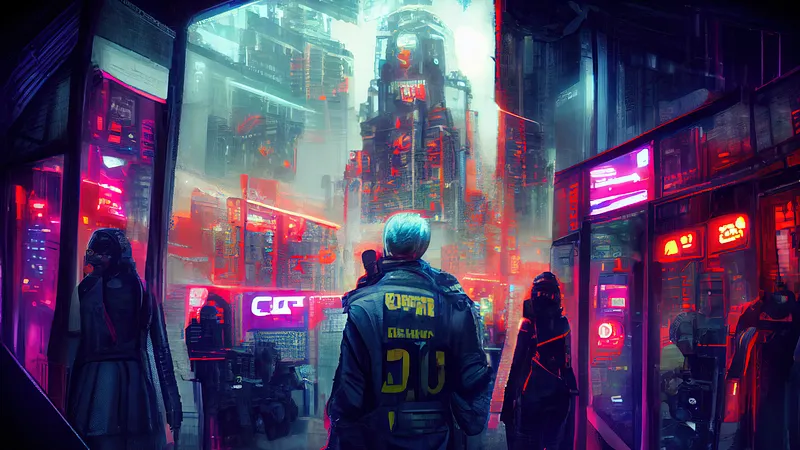
source: @Neirfy
While I sit here in my office looking at several screens at the latest news in AI and Robotics, I can’t help to feel a sense of deja vu.
The humanoid robot from Figure that does the dishes better than a teenager, seems to have stepped out of the pages of a Cyberpunk novel. On the other screen I see a video of a person with a neural interface from Neuralink, announcing how happy he is he can play video games again, and I think this could be a scene from the “Matrix”.
It’s moments like this that makes me wonder: are we living in a world shaped by science fiction, or are we simply witnessing the natural evolution of technology?
It’s a question that I have asked myself a lot over the years. When the first mobile phone from Motorola was announced, the first time we saw video calling and many more times in between.
The Birth of Science Fiction and AI
Let’s start with one of the first movies, we go back to 1927 where we get a first glimp of Fritz Lang’s “Metropolis”. As the humanoid robot Maria takes form, transforming from cold metal into a lifelike beauty. Keep in mind that at that moment the most advanced computing device was a mechanical calculator.
Machine learning wasn’t even a thing, it started in the 1940s. You can read about the history of AI in my article “The Evolution of Artificial Intelligence: From Ancient Tools to Modern Marvels”.
The Present: Science Fiction Becoming Reality
Fast-forward to today, and we find ourselves in a world where the robots from Boston Dynamics perform acrobatics that make a gymnast jealous.
The line between science fiction and reality is getting thinner by the day, leaving me to wonder.
The Technium: Natural Evolution of Technology?
Kevin Kelly introduced me, in his book “What technology wants”, to the concept of the “Technium”. The idea that technology evolves naturally, just like biological organisms. It’s a compelling idea, supported by numerous examples of inventions through history.
Consider the telephone. In 1876 Alexander Graham Bell and Elisha Gray filed a patent for this world changing device on the same day, in different cities. It’s as if the telephone was an idea whose time had come. We see similar patterns with radio, the computer and other innovations.
Radio:
- 1893: Nikola Tesla in the USA demonstrated wireless communication.
- 1894: Oliver Lodge in England demonstrated wireless signaling.
- 1895: Guglielmo Marconi in Italy demonstrated long-distance radio transmission.
Computer
- 1941: Konrad Zuse in Germany created the Z3, the first programmable computer.
- 1943: Tommy Flowers in England developed Colossus, the first electronic digital computer.
- 1946: J. Presper Eckert and John Mauchly in the USA built ENIAC, the first general-purpose electronic computer
These “coincidences” suggest that it was a predestined path of technological evolution. The time was their, it was somewhere in the air waiting for someone to pluck it out of the ether. But is this really the way technology evolves or are there other influences?
The Influence of Science Fiction
While I think about this question, I’m drawn to the worlds of William Gibson, Phillip K Dick, and Isaac Asimov. Long before the first computer chip was created, these futurists were painting vivid pictures of a potential future.
Gibson’s “Neuromancer” not only coined the terms “cyberspace” and “matrix” but presented a world of human-machine interfaces that looks a lot to our current “virtual reality”, “metaverse” and the attempts of Neuralink.
I remember the first time I read “Neuromancer”, cozy on my sofa, lost in a world of cybernetic implants and AI constructs. At the time it seemed pure fantasy, something that maybe one day would be possible but not the first 100 years.
Now, as I watch videos of people controlling video games with their thoughts. I think about the first time Case jack’s into the “Ono-Sendai cyberspace deck” to connect to the “matrix”, and I can’t help but wonder:
Did Gibson’s vision help shape this reality, or did he tap into the “Technium” knowing that it’s the flow of technological progress?
Asimov’s Three Laws of Robotics, introduced in “I, Robot”, continue to shape the discussions on AI ethics today. As we struggle with the impact of autonomous AI systems, these laws serve as a baseline, a starting point for our ethical frameworks.
A few months ago we all saw Figure 01 sorting dishes, providing an apple, sort trash and have a conversation. A few months later that same robot was creating car parts in a BMW factory.
Works like Ghost in the Shell delve deeply into questions of what consciousness is and whether artificial beings can truly be sentient. The protagonist Major Kusanagi grapples with her own nature as a cyborg and what it means to have a “ghost” (consciousness) in her artificial “shell”.
This raises philosophical questions about the nature of consciousness and whether it can be replicated in artificial beings.
It’s proof of the power of fiction that a set of rules invented for short stories now informs real-world policy discussions.
Science Fiction in Everyday Life
But it’s not just the big ideas that science fiction predicted. It’s the small details, that often feel like their ripped from the pages of a novel. When I use my smartphone to make a contactless payment. I’m reminded of the “credsticks” from Gibson’s “Neuromancer”.
When I see ads targeted based on my online behavior I think of the billboards that show the wanted poster when Bruce Willis is on the run in “The Fifth Element” or that scene in “Minority Report”.
As I delve deeper into this fine line between imagination and innovation, I’m struck by how science fiction serves as both a catalyst and a guide for technological development. It provides a sandbox for exploring possible futures and technologies.
Allowing us to think about the impact of emerging technologies before they become reality. It helps us to navigate the ethical minefield of technological progress.
Yet I can’t help but wonder, would we be on the same technological road without these fictional stories?
The underlying principles of computation, robotics and AI would likely have been developed anyway. But the specific forms of technology and the way we integrate them into our society seems to be infused with our collective imagination fueled by science fiction.
The Future: Science Fiction Becoming Reality
Today we stand on the brink of transformative AI capabilities that will change the world. Companies like OpenAI, DeepMind and Neuralink are pushing the boundaries of what’s possible.
The first time I had a voice conversation with ChatGPT made me realize that “Her” was not longer science fiction. The concept of a “neural lace” from Iain Banks’ Culture series inspired Elon Musk in the development of Neuralink, a brain-computer interface technology.
The dialog between science fiction and technological reality is louder than ever.
Mustafa Suleyman predicts that within five years, AIs will communicate with each other and acting on behalf of humans. And Ray Kurzweil suggests we’ll achieve human level AI by 2029 and reach the technological singularity by 2045.
These timelines, once the stuff of future speculation, now feel very close. And with them come the ethical concerns which were long explored in Cyberpunk fiction. Mass surveillance, loss of privacy, AI dominance, body enhancements. These are no longer future possibilities but urgent concerns that demand our attention.
Conclusion: The Power of Imagination
As I reflect on this dance between fiction and reality, I’m reminded of the Arthur C. Clarke’s famous quote:
“Any sufficiently advanced technology is indistinguishable from magic.”
Perhaps the true power of science fiction lies not in its predictive accuracy, but in its ability to inspire us to create the future we desire and to avoid the pitfalls we fear.
In the end, whether our technological future is predetermined or shaped by science fiction may be less important than the fact that we are actively engaging in this dialogue. By continuing to imagine, to question, and to create, we ensure that our technological evolution serves its progress and has the best interests of humanity.
As we move forward into this complex technological landscape, let us remember the power of science fiction. They are not mere entertainment, but blueprints of our future. A future we have the power to shape, one page, one invention at a time.
So dear reader, I leave you with these questions. As we stand at this crossroads of imagination and innovation, what stories will we tell, and what world will we build? Are we living in a world shaped by science fiction, or are we simply witnessing the natural evolution of technology?